The Hefner Mouthpiece Box
Last updated: July 17, 2024
Catalogs
- Amati-Kraslice Catalog (2014)
- Arnold Stoelzel mouthpiece catalog
- Amati-Kraslice Catalog (2018)
- Benge Mouthpiece Catalog
- Blessing Catalog (2018)
- Conn-Selmer/UMI Catalog
- Conn-Selmer Non-Bach Mouthpiece Info
- Conn Flugel Catalog (with 20A reference photo)
- Getzen Mouthpiece Catalog (1970)
- Lignatone:
- Olds Catalog (1962)
- Olds Bugle Catalog (1970)
- Rudy Muck Catalog (partial)
- UMI CKB/Conn/King/Benge Brass Mouthpiece Catalog
- UMI E-Z Tone and Unbranded Mouthpiece Catalog
- Weirl Brazil Catalog
Mouthpieces
General
- AMATI-KRASLICE 1-1/2, 1990S (LARGE MORSE TAPER)
- AMATI-KRASLICE 1-1/2F VIRTUOSO HEAVY, 2000S (LARGE MORSE TAPER)
- AMATI-KRASLICE A16 (A91 SERIES) NATURAL/SIGNAL TRUMPET
- AMATI-KRASLICE A51 (A19 SERIES) NATURAL/SIGNAL TRUMPET
- AMATI-KRASLICE 1.5F VIRTUOSO HEAVY, 2000S (LARGE MORSE TAPER)
- AMATI-KRASLICE MAESTRO 3 (CORNET) & AMATI-KRASLICE MAESTRO 10 (CORNET)
- AMATI-KRASLICE VIRTUOSO 3 AND AMATI-KRASLICE VIRTUOSO 10
- AMATI-KRASLICE 7BV
- AMATI-KRASLICE 7EW AND AMATI-KRASLICE 7EW (CZECH REPUBLIC)
- AMATI-KRASLICE 10
- ARNOLDS AND SONS A&S 6T
- UNMARKED POSSIBLE AMATI-KRASLICE? 3B (CORNET)
- BESSON UNMARKED (MELLOPHONE)
- BLESSING USA 3C
- BLESSING 4
- CIRCE P
- COURTOIS 1-1/4C
- COURTOIS 1-1/2C
- FLIP OAKES 3
- FLIP OAKES X5
- GETZEN 3C
- UNMARKED POSSIBLE GETZEN 12
- JUPITER 12FL
- MARTIN 3 1910-1920S (CORNET)
- NADERTON 12S
- REYNOLDS (OLDS) 16
- OLDS 27
- OSMUN 6V
- PARROT 1 & 2
- SCHILKE 8E2
- UNKNOWN UNBRANDED POSSIBLE BOHM-MEINL 1950S-1690S GERMANY
- UNMARKED 1 (POSS. CARL FISCHER) AND UNMARKED 2 (POSS. CARL FISCHER)
- UNMARKED 17C
- UNMARKED FLUGELHORN MOUTHPIECE (SMALL MORSE TAPER)
- YAMAHA 7D4D (CORNET)
- YAMAHA 8D2 (CORNET)
- YAMAHA 8E2
- YAMAHA 9E
Bach
- BACH 1X FL CUSTOM MEGATONE (SMALL MORSE TAPER)
- BACH CORP 3CW
- BACH 3D
- BACH 5V (CORNET)
- BACH 7BW NARROW LETTERS AND SPACING
- BACH 7BW NARROW LETTERS AND WIDE SPACING
- BACH 7BW ROUND LETTERS AND WIDE SPACING
- BACH 7BW FLUGELHORN (SMALL MORSE TAPER)
- BACH 9AT (ALTO TRUMPET)
- BACH 10 (LARGE LETTERS 1997-2003)
- BACH 10-1/2S (COMMERCIAL)
- BACH 10-3/4CW (MEGATONE) AND BACH 10-3/4EW (MEGATONE)
United Musical Instruments mouthpieces, made by Lausmann
- BENGE 1
- BENGE 3 (CORNET)
- BENGE 4SC
- BENGE 5B
- BENGE 5B (CORNET)
- BENGE 5-1/2SC
- BLESSING 14A4a, LAUSMANN OEM
- BLESSING USA 3C
- BLESSING USA 3FL
- CKB MELLO 6
- CONN 3
- CONN 5-1/2SC (CORNET)
- CONN 7 (SHORT SHANK/UK)
- CONN 10-1/2CW
- CONN FLUGELHORN PRECISION (CORNET)
- CONN FLUGELHORN IMPROVED PRECISION (CORNET)
- CONN COMMODORE 7 (CORNET)
- LAUSMANN UNBRANDED STENCIL
- UNMARKED PAN AMERICAN (CORNET)
- WERIL VFL 6V
Mouthpieces
AMATI-KRASLICE 1-1/2, 1990S (LARGE MORSE TAPER)
 |
 |
 |
 |
 |
AMATI-KRASLICE 1-1/2F VIRTUOSO HEAVY, 2000S (LARGE MORSE TAPER)
"Virtuoso" is the newer heavyweight design.
 |
 |
 |
 |
 |
 |
AMATI-KRASLICE A16 (A91 SERIES) NATURAL/SIGNAL TRUMPET
 |
 |
 |
 |
 |
 |
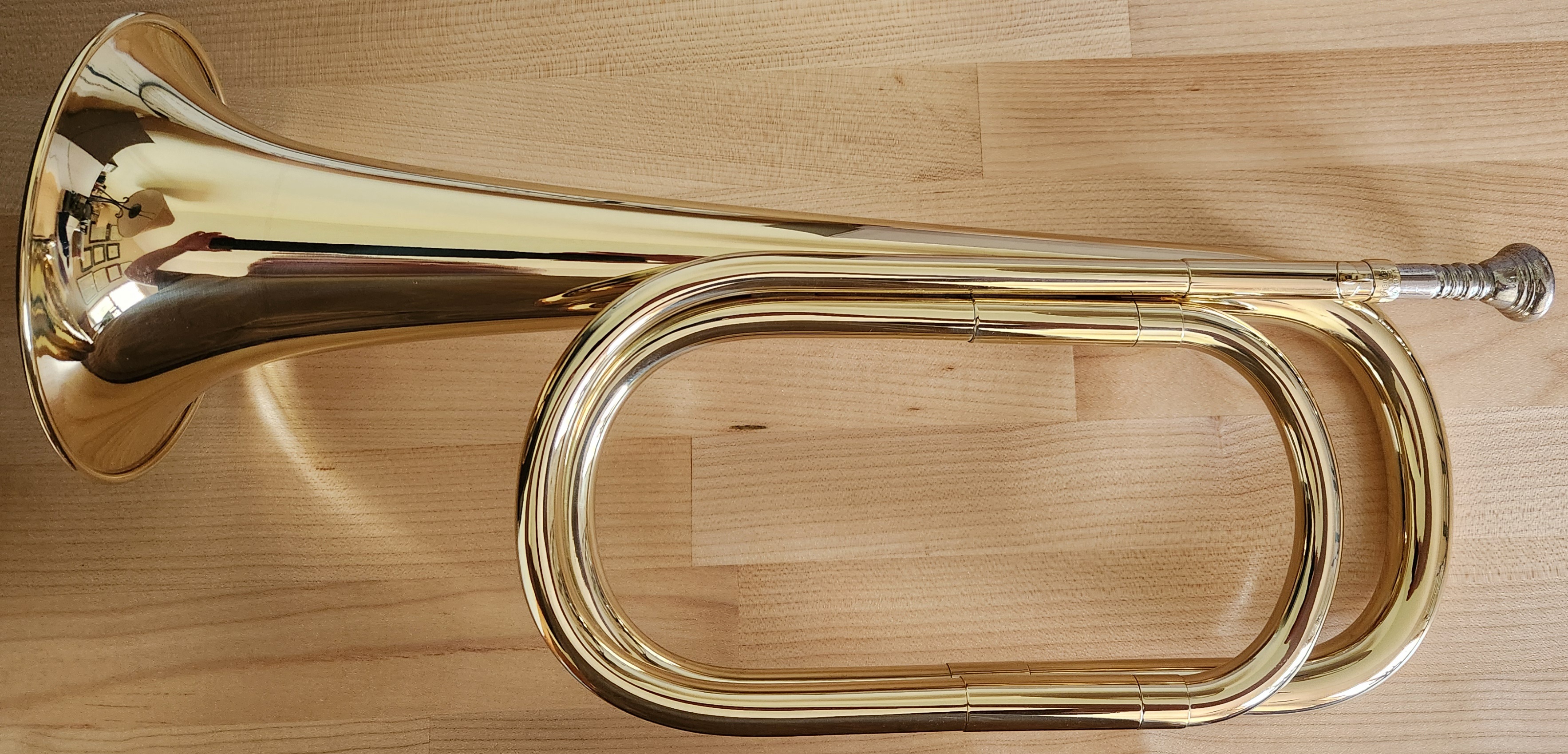
AMATI-KRASLICE A51 (A19 SERIES) NATURAL/SIGNAL TRUMPET
 |
 |
 |
 |
 |
 |
AMATI-KRASLICE MAESTRO 3 (CORNET) & AMATI-KRASLICE MAESTRO 10 (CORNET)
These were ordered made well before 2020, and are part of the 2014 catalog's "Maestro" series, used to designate these older Bach clone mouthpieces. "Virtuoso" is the newer heavyweight design.
These have UPCs 8 591278 022921 (3) and 8 591278 022600 (10), though the tool marks and design indicate these were made with Amati's older tooling and processes, and like so many of these Amatis, there is no brand name marked. Of all the various NOS Amati cornet mouthpieces encountered, these were the best-made and best-playing - solid competitors to their Bach counterparts.
AMATI-KRASLICE VIRTUOSO 3 AND AMATI-KRASLICE VIRTUOSO 10
Purchased in 2020, these are slightly older but still from the late 1990s or later. They have the heavyweight blank most Amati-Kraslice high brass mouthpieces use, based on the Yamaha heavy design, with UPCs 8 591278 078461 (3) and 8 591278 078386 (10). These have slightly different rim/cup profiles than the older series, but are still good players. The quality and consistency is significantly higher than the Maestro series, but the Virtuoso designs might not be preferable.
AMATI-KRASLICE 7BV
Just marked Amati in the manner of 1950s pieces, with a crudely-stamped model on back – cup is very close to the Schilke 7B4, and if the V is a Roman numeral 5, this Amati piece would resemble a Schilke 7B5 cup if such existed.
 |
 |
AMATI-KRASLICE 7EW AND AMATI-KRASLICE 7EW (CZECH REPUBLIC)
Crudely stamped, with an off-spec cup unlike any other maker's 7EW, and the latter has additional stamp indicating it was made (or at least prepared for export) after 1992.
AMATI-KRASLICE 10
Based on the Vincent Bach design, this came with a 1980s Amati ATR-302 "Senator"-type trumpet, and was a good match for the Amati ABG-223 G/F bugle on anything requiring faster articulation.
 |
 |
 |
 |
 |
 |
UNMARKED POSSIBLE AMATI-KRASLICE? 3B (CORNET)
This one is unmarked but identical in blank to several Amati-made cornet pieces I've encountered, though there is variation there as well! The cup is nearly identical to Bach 3B.
 |
 |
 |
ARNOLDS AND SONS A&S 6T
 |
 |
 |
BESSON UNMARKED (MELLOPHONE)
 |
 |
 |
BLESSING USA 3C
The Blessing USA 3C is another Warburton OEM piece. The cup looked a bit different than the Bach versions, and it indeed has a marginally "flatter" cup and barely-tighter shoulder than the Bach scan in VennCAD. The rim is also wider and flatter, in keeping with Blessing superiority - even more so than the Lausmann stencil version!
BLESSING 4
 |
 |
 |
 |
 |
 |
CIRCE P
This mouthpiece was included with a Amati-Kraslice piccolo trumpet, purchased by Tom Siebenhuhner at Giardinelli NYC in 1975 - Circe was a tradename for products alongside Lignatone, often appearing on or with slightly more "specialty" pieces.
 |
 |
 |
COURTOIS 1-1/4C
 |
 |
 |
COURTOIS 1-1/2C
 |
 |
 |
FLIP OAKES 3
 |
 |
 |
FLIP OAKES X5
 |
 |
 |
GETZEN 3C
|
||
 |
 |
 |

The Getzen 3C flugel piece comes around periodically, and is designed & marked in accordance with the trumpet/cornet models of the 1970s.
UNMARKED POSSIBLE GETZEN 12
 |
 |
 |
JUPITER 12FL
The Jupiter 12FL was standard with the SFH-646 [Benge-style flugelhorn, often seen as "Centurion"] and SFH-746 [horizontal valve slide flugel, much like Yamaha YFH-2xx]. These pieces seem to be mostly from the 1980s-1990s, eventually replaced sometime in the 2000s. A previous example I had would fit rather well into both Large and Small Morse Taper shank receivers, so I need to test this one out as well...
 |
 |
 |
 |
 |
 |
MARTIN 3 1910-1920S (CORNET)
 |
 |
 |
 |
 |
This has the 1970s blank, but no other marks. The cup is deep and is suited to bugle, mellophone, and possibly was intended for the Getzen Frumpet, but is not listed in the 1970 catalog as such.
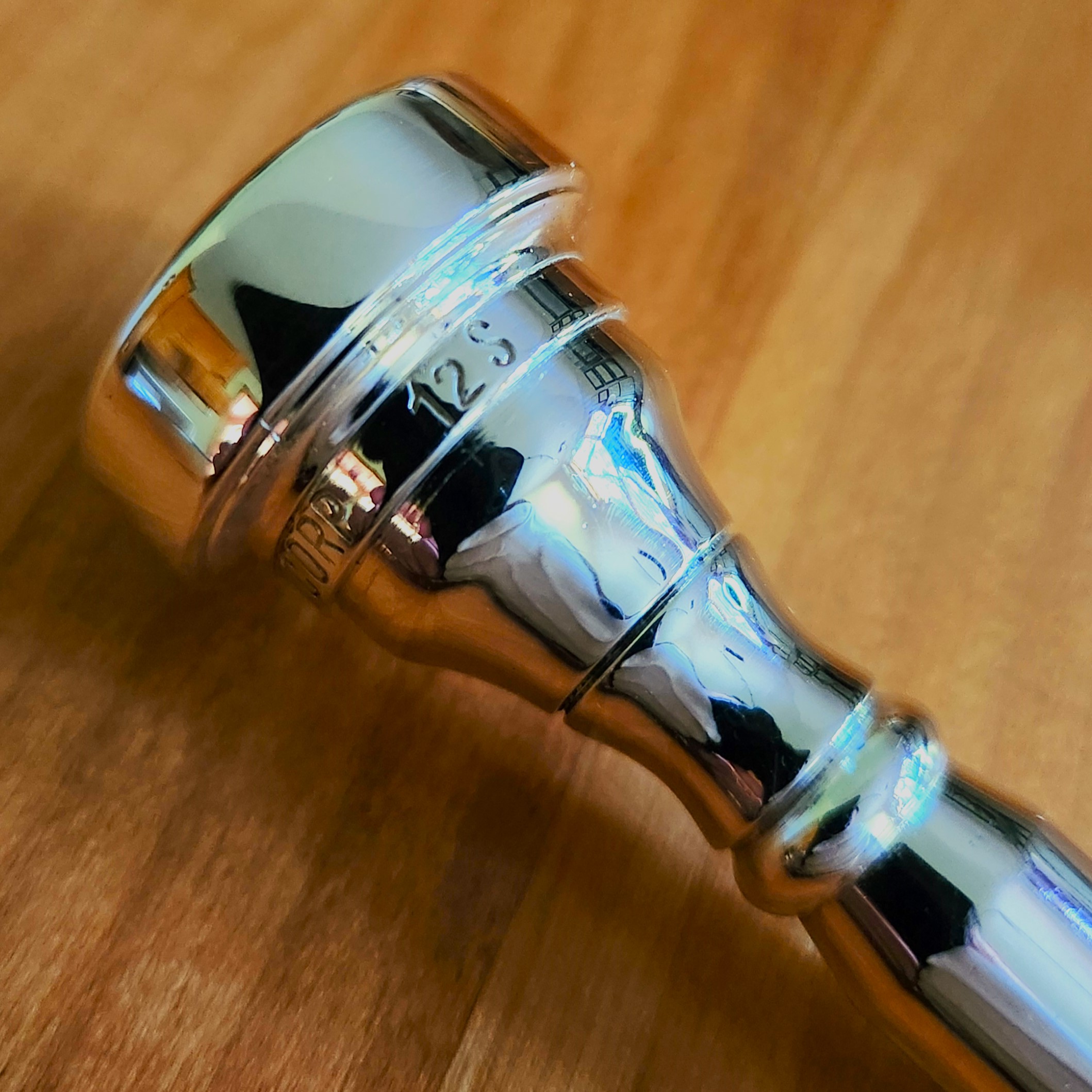
NADERTON 12S
 |
 |
 |
|
||


REYNOLDS (OLDS) 16
This piece, supposedly intended for Zig Kanstul's marching mellophone (with the 17 for flugelhorn), was available in both streamlined heavyweight and Giardinelli-esque blanks over the years. The Reynolds version was the best I've encountered, and for a desirable mouthpiece model, I wanted to make sure a scan was made.
_16/Olds_16-03.jpg) |
_16/Olds_16-01.jpg) |
_16/Olds_16-02.jpg) |
OLDS 27
The Olds 27 was originally a bit of a mystery - I had one with the standard heavy Olds blank/cursive font that was misplaced while being tested. The Olds 27 has a wider diameter but roughly same cup depth as the Olds 16. This example was a replacement with a much worse rim and the older "blocky italic" Olds logo, but same heavy blank. See one in [brief] action at https://www.youtube.com/watch?v=GzgJ8doUU20 While I had read about this Olds 27 appearing as an Olds large-shank cornet piece, the larger trumpet shank and short profile here would indicate it's intended for trumpet-shank mellophones of some sort.
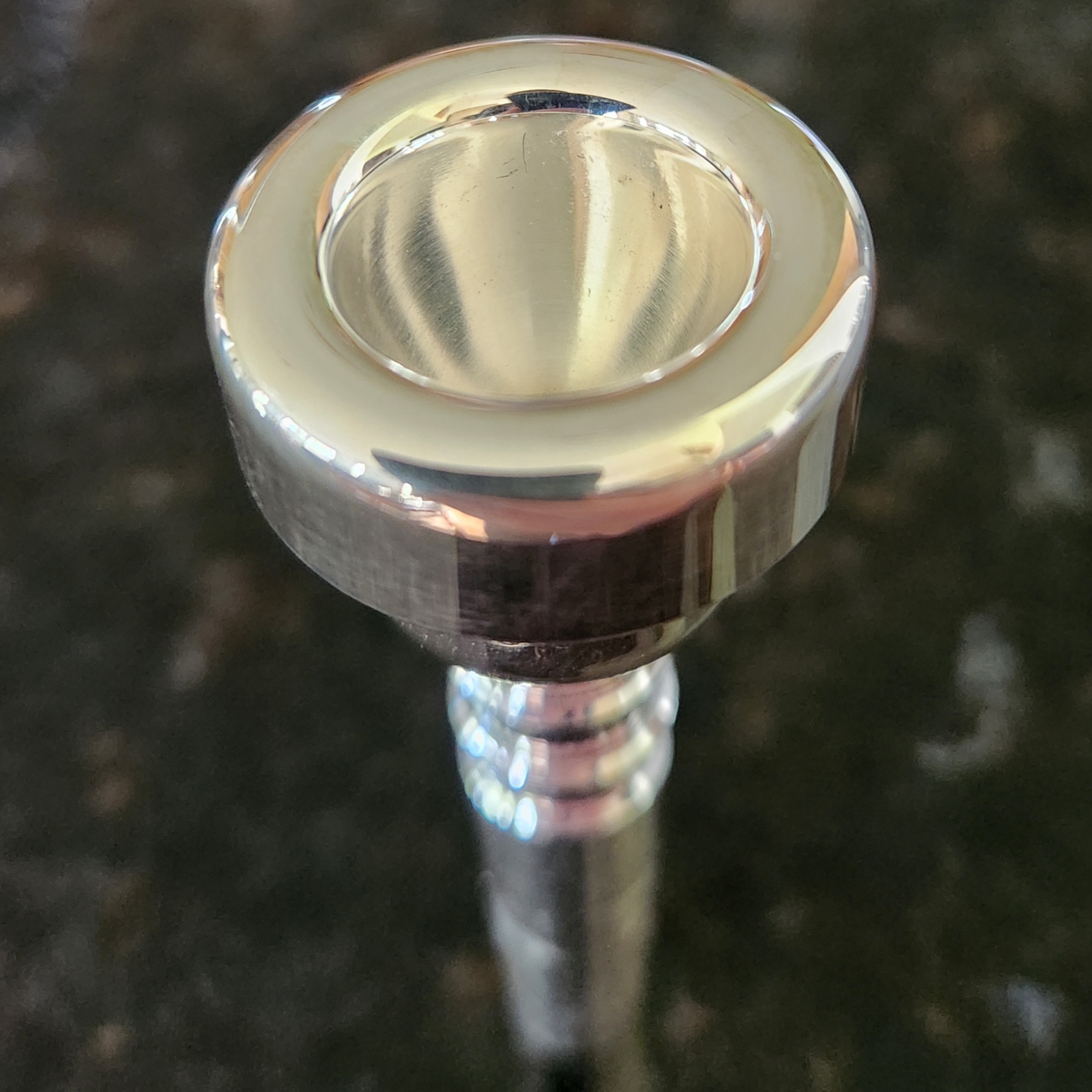
OSMUN 6V
The Osmun 6V is their take on the Mello 6. I find it well-matched to the Amati-Kraslice ABG-203 bugle [the short, British-style B-flat one like Stowasser made before Amati], but a bit stifling with the ABG-223 G/F bugle. It's mentioned in this TrumpetHerald thread, but the Osmun website and eBay listing aren't often available (see also: this cached version).
 |
 |
 |
 |
 |
PARROT 1 & 2
 |
 |
 |
 |
 |
 |
SCHILKE 8E2
 |
 |
 |
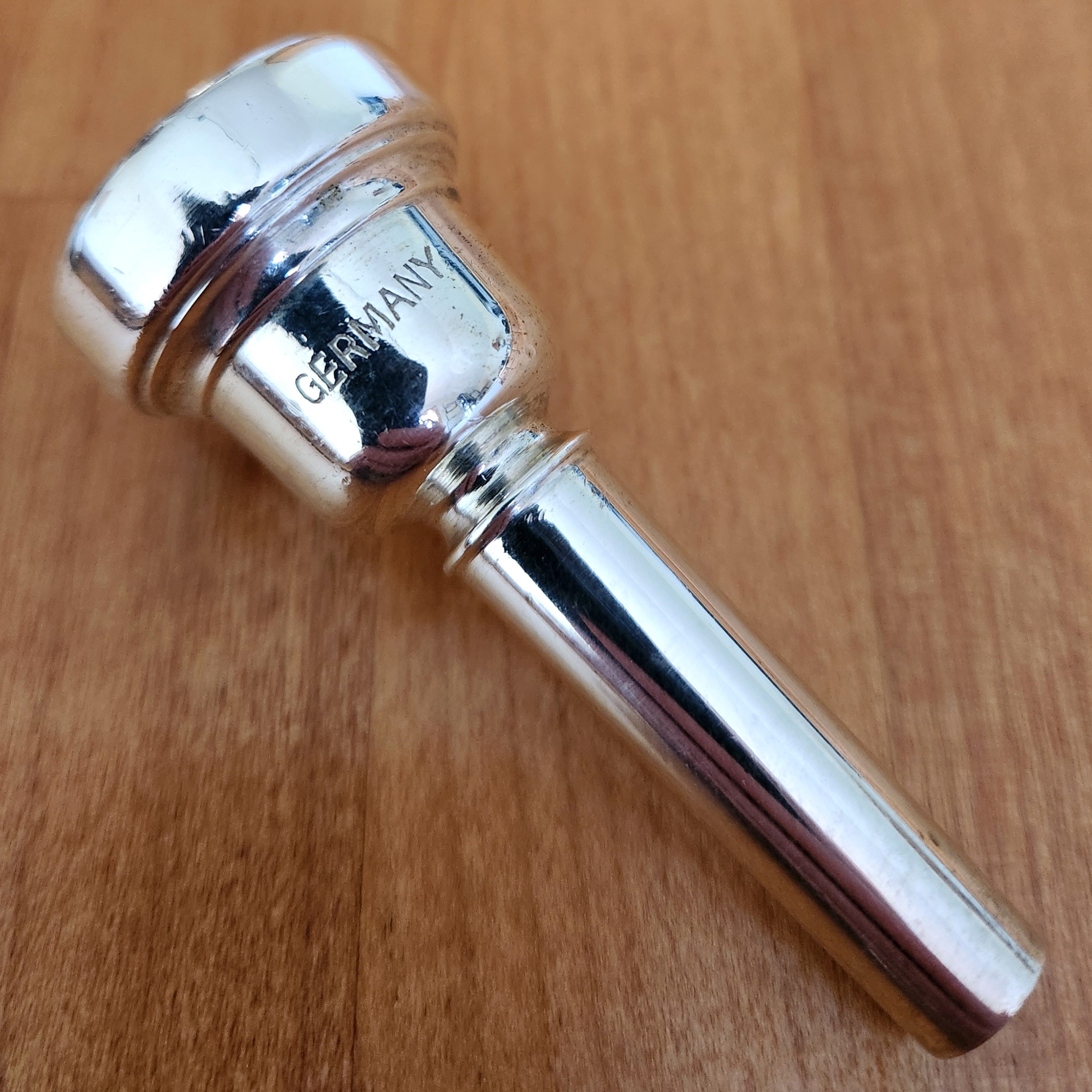
UNKNOWN UNBRANDED POSSIBLE BOHM-MEINL 1950S-1690S GERMANY
 |
 |
 |
 |
 |
 |
UNMARKED 1 (POSS. CARL FISCHER) AND UNMARKED 2 (POSS. CARL FISCHER)
 |
 |
 |
| Unmarked 1 (Top View) | Unmarked blank | Unmarked 2 (Top View) |
These have that "truncated conical" Rudy Muck look, and per Chris Dankler, these were made for distribution with Carl Fischer-distributed trumpets, and [often] are close to the 15S design. I add "often" because these are rather different dimensions, despite having a similar theme overall. Perhaps that was just a result of quality control in order to meet quotas...
UNMARKED 17C
 |
 |
 |
UNMARKED FLUGELHORN MOUTHPIECE (SMALL MORSE TAPER)
 |
 |
 |
 |
| Tan/orange background shows fit with the modern Amati-Kraslice AFH-201 (B-226) receiver | Blue background/brass bell shows fit with a Swiss Willson stencil Conn 24A receiver | Blue background/rose bell shows fit in Chinese stencil Thomann receiver | Brass receiver/silver tube shows fit in a Conn 1F Vintage One receiver |
This appears to be the Chinese answer to the Yamaha 14F4 rim/cup, but with a slightly longer small shank. These were shipped with Chinese copies of Yamaha flugelhorns for years until they gradually shifted toward 3CFL and 1-1/2CFL clones (though I still see these unmarked unique ones occasionally).
YAMAHA 7D4d (CORNET)
 |
 |
 |
YAMAHA 8D2 (CORNET)
 |
 |
 |
YAMAHA 8E2 (OLD)
 |
 |
 |
YAMAHA 9E (1980S EDITION)
 |
 |
 |
Bach Mouthpieces
I purchased many of these since 2018, and it was striking how varied the cup shapes and depths were, contrasted with the standard goblet-shaped cups in the Kanstul comparator. For smaller rim sizes, they often seemed to use a straight V funnel on these newer pieces. Since older Bach Corp. flugel pieces tend to use that shape, I generally presume that the goblet-shaped cup examples are older, or at least were produced to older specifications. In the 17CFL's case, the lettering is narrow, there is no Corp., the model stamp is next to the brand [not on the opposite side, as custom mouthpieces are], and the model stamp is wider/different than the brand font, which would indicate 1990s-early 2000s. Around 2003 is when the large-letter Bach trumpet/trombone pieces gave way to a narrow font, with the model lettering in the same narrow type as the brand. I have never seen large-letter cornet/flugel pieces, nor any reference to them yet, so I would think pieces like the 17CFL I have would predate the mid-2000s.
Sometime around the mid-2010s, it appears Bach began offering flugelhorn mouthpieces in more sizes. They appeared through the usual Guitar Center retail stores on eBay, and it seems they combined the rim of choice with a straight V funnel. Sizes like the 3D, which never had an associated flugel piece, now had one to complement your cornet & trumpet versions. I don't have any information regarding this decision or rationale, but it is interesting to see how even that "standardization" varied, with funnel depths sometimes changing in relation to rim size or given rim/cup combinations [10¾CWFL and 10¾EWFL - the latter has a shallower V funnel, and the 11DWFL is a funnel compared to the shallower goblet of the 11EWFL].
By contrast, I only purchased the Bach 10FL around 2020 or 2021, but it still has a more goblet-shaped cup. The cup/throat shoulder is a bit sharp compared to older designs, so I really can't say for sure where it falls other than post-2003. I don't think the stamping depth says much either... Packaging doesn't mean much [assuming your box is original to the mouthpiece], but boxes marked "The Selmer Company" predate Conn-Selmer's official merger in 2003. Perhaps old stock boxes were available into 2004. Being an oddball in and of itself, the Bach 5V's equivalent flugelhorn mouthpiece is...the same as the cornet/trumpet version, just with a wider backbore and shank.
BACH 1X FLUGELHORN CUSTOM MEGATONE (SMALL MORSE TAPER)
 |
 |
 |
 |
 |
BACH CORP 3CW
 |
| Bach 3B vs. Bach 3CW vs. Bach Corp. 3CW |
The Bach Corp. 3CW was a later result of an experiment. Since Kanstul's comparator shows the 3CW as a wide-rim 3B, I decided to investigate. None of the 3CWs I acquired - new trumpet, new cornet, vintage trumpet, etc. had the 3B cup! All of the 3CWs were just that - wider-rim 3Cs. This is a 1980s example, but is basically the same as the 3C-cup in newer examples.
BACH 3D
The Bach 3D is strikingly similar to the Yamaha 14A4a and Blessing 14A4a - some in my family found it a great all-round design, and it does have more support than the 3C. I had a couple other ratty examples I sold years ago, but I recall they were similar to this.
BACH 5V (CORNET)
The 5V has "18" stamped rather crudely after 5V, making me wonder if that's the throat size? It's not stamped on the collar or shank, so I don't think it has to do with the backbore... The 10 I purchased new around 2020 or 2021, and I don't know its exact age [it's just different from the 1997-2003 large letter one I had scanned, on your site already]. The Amati is the standard "Virtuoso" heavyweight one included with all AFH-201 [B-226] and AFH-601/etc. models.
BACH 7BW NARROW LETTERS AND SPACING
A favorite all-round design, with a more comfortable rim and deeper cup than the ubiquitous 7C.
 |
 |
 |
BACH 7BW NARROW LETTERS AND WIDE SPACING
A favorite all-round design, with a more comfortable rim and deeper cup than the ubiquitous 7C.
 |
 |
 |
BACH 7BW ROUND LETTERS AND WIDE SPACING
 |
 |
 |
BACH 7BW FLUGELHORN (SMALL MORSE TAPER)
 |
 |
 |
 |
 |
 |
BACH 9AT (ALTO TRUMPET)
 |
 |
 |
 |
 |
 |
BACH 10 (LARGE LETTERS 1997-2003)
This large-letter piece (1997-2003) was purchased for comparison to the Amati-Kraslice version, and it has a slightly different rim/cup profile than the later Bach cornet version.
BACH 10-1/2S (COMMERCIAL)
NO DESCRIPTION
 |
 |
 |
BACH 10-3/4CW (MEGATONE) AND BACH 10-3/4EW (MEGATONE)
Ordered custom in December 2020 and arriving early 2021 [bearing the distinctive custom stamped model equidistant-opposite the Bach branding], these are modern descendants of the 17C1 and 17C2, ostensibly based on the Rudy Muck models. Just as so many heavyweight-marching trumpet mouthpiece sets have the 1/Lead and 2/Support models (roughly 3E and 3C cups, respectively), these are much more comfortable and fitting for those who want something smaller than the enormous current selections. The 10-3/4EW was the basis for a thesis project on rapid prototyping and gaps in the market, and the 3D rendering is much like the Vennture duplicate I own.
United Musical Instruments mouthpieces, made by Lausmann
BENGE 1
Symphonic piece that also appears in cornet form, but not especially common
 |
 |
 |
BENGE 3 (CORNET)
Purchased to compare with the late-Abilene Conn equivalent I used to use, this was available New Old Stock for a time - definitely recommended over just switching to a 3C.
BENGE 4SC
Chuck Ward designed this personal favorite of mine back in the 1980s, and a great high note piece as well as all-around commercial playing - I particularly liked it with the King 1117 marching trumpet on the field, though the 4SC doesn't have quite the support of its 5½SC sibling!
 |
 |
 |
BENGE 5B
 |
 |
 |
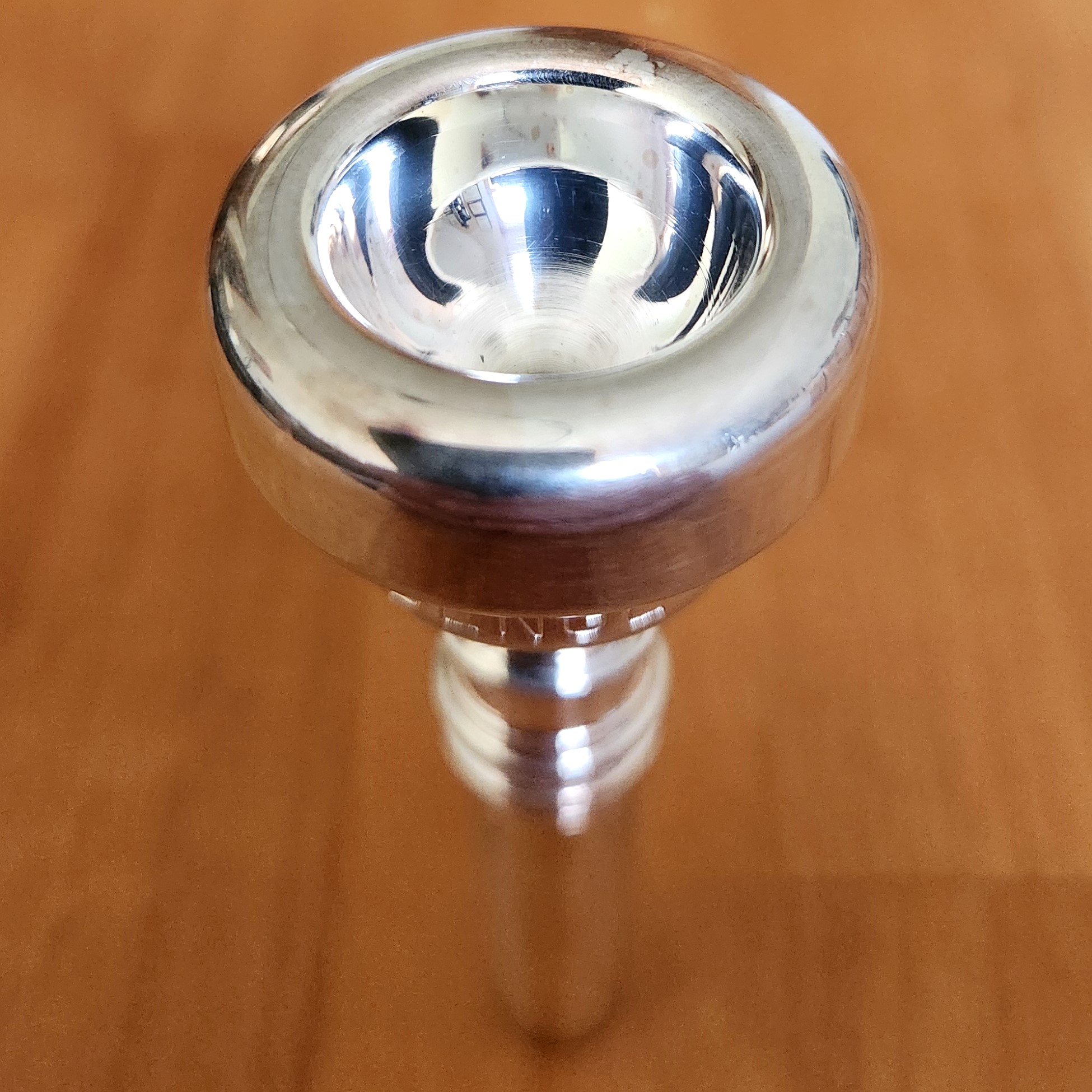
BENGE 5B (Cornet)
 |
 |
 |
BENGE 5-1/2SC
To paraphrase a trumpet great, this was my first "real" mouthpiece...outside the standard paradigm of medium cup, Conn 4 and a billion 7Cs. Another Chuck Ward design dating to the 1980s, this helped me discover the versatility of cornets based on the mouthpiece (especially the Yamaha YCR-731). Once I acquired a trumpet version, I was set.
BLESSING 14A4a, LAUSMANN OEM
I had noticed this and got one out of curiosity, and while not a favorite, it might help someone realize that they shouldn't buy a 1½C to play higher than on their 5C, or that Schilke isn't the only 14A4A...! I happen to have photos of a Benge 13A4A, which clued me in on the non-Bach models Lausmann produced, so when the Blessing 14A4a appeared, I was keen to see it.
 |
 |
 |
BLESSING USA 3C
NO DESCRIPTION.
 |
 |
 |
BLESSING USA 3FL
The Blessing USA has the distinctive Warburton font - these are the very pieces "made by Warburton in Florida" once mentioned on their website. The cup depth meant I had to play around with the rendering in and out of VennCAD, but it worked as Mellophone with the shank diameter manually added.
 |
 |
 |
 |
 |
 |
CKB MELLO 6
The UMI CKB Mello 6 is the classic model with the heavier blank, about which little needs said! This page discusses it well. I wasn't sure which exterior was truer to life [this heavy Frusta kind of imitates the mass, but the light-setting Korbeto looks closer outside the cup], but the Frusta is what I chose here.
 |
 |
 |
CONN 3
Another UMI-era piece identical to the Benge version, which I prefer to the average 3C for a full sound (though not high register).
CONN 5-1/2SC (CORNET)
A fantastic shallow cornet mouthpiece, the Benge version of which allowed me to really improve and branch out.
CONN 7 (SHORT SHANK/UK)
Also appears under Earlham and Besson names from time to time, as it seems this design is not proprietary to UMI/Conn-Selmer as the previous ones, but this was another piece to broaden the Yamaha YCR-731's tonal palate, as an improvement over the Abilene Conn 3, Bach 5A, and Bach 5V
CONN 10-1/2CW
I keep an eye out for the UMI/CKB/Conn/King/Benge versions of Bach mouthpieces, and I made a note of this one after seeing it in a 1988 Benge catalog. It's better than the modern Bach equivalent (the sharp bite and rapidly sloping rim are insanely uncomfortable), though older Bach implementations with flatter rims are competitively comfortable.
 |
 |
 |
CONN FLUGELHORN PRECISION (CORNET)
 |
 |
 |
CONN FLUGELHORN IMPROVED PRECISION (CORNET)
These three were all from Chris Dankler's clearinghouse, and are interesting partly because Conn flugelhorn pieces are not often seen. The first has a classic Precision blank from the 1930s (possibly early 1930s when the old-style designs were made with Precision exteriors), with faint lengthwise CONN stamp. It may be the continuation of the 1920s model (referenced here) and its internal profile is identical to the second, which is unmarked but with the distinctive Pan American "All ? Star" blank exterior. The third is the Improved Precision "Conn Fluegel" from the 1960s, included with the 20A flugelhorn as standard. It has a different profile altogether, and works well with cornet, but is not as rich as the UMI Conn 7 in the same roles.
 |
 |
 |
 |
 |
CONN COMMODORE 7 (CORNET)
One of the many Rudy Muck-type mouthpieces out there (possibly even a Muck stencil, considering how many of these he supposedly made for others), and a decent medium-shallow piece all around - well-matched for the large-bore Conn cornets of the 1960s.
LAUSMANN UNBRANDED STENCIL
The Lausmann unbranded stencil was distributed by DEG [who sourced most of their standalone mouthpieces from them], and the blank has a distinctive bulge in the collar. These are usually Small-Morse, but I have others with slightly different shank dimensions [not to mention the French-shank model 6]. The model stamp has a different font early on, later changing to the distinctive 6 seen on Conn, Blessing, and other Lausmann clients from the late 1980s onward.
 |
 |
 |
UNMARKED PAN AMERICAN (CORNET)
WERIL VFL 6V
The Weril VFL 6V is stamped [crudely] in the manner of Lausmann pieces, but their older examples have different dies for the ½ symbol, varying tool marks, and slightly different proportions from old Lausmann pieces. This has a distinct blank unlike most other Weril pieces I've seen since, and the Weril brand stamp indicates this is an older example. At some point in the early 2000s, Weril added new CNC machines for mouthpiece production, and this is where the infamous W46 comes from. These CNC-made pieces don't have the Weril brand name, the model lettering is slightly different [though modeled on the previous style], and the exterior edges are often a bit sharp. This was when they marketed copies of models from different manufacturers in one lineup (linked here).